The Japanese government is thrown into a tailspin when Godzilla emerges from the ocean depths and starts trampling Tokyo, which had presumably only just been rebuilt from the last time this happened.
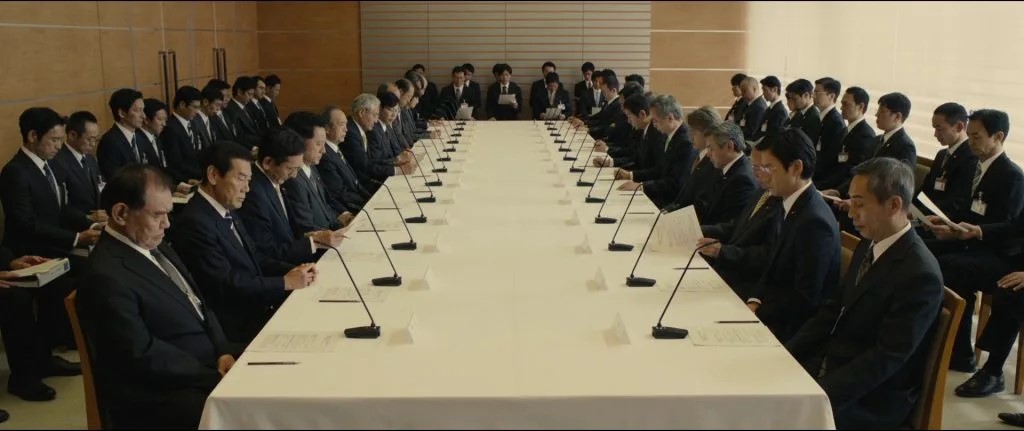
Coming up with fresh takes on a 60-year-old character is no easy task, but this 2016 reboot manages to do something new while staying true to Godzilla‘s nuclear roots. This time the monster stands in for the 2011 tsunami, and the film satirises the Government response to the subsequent nuclear disaster at Fukushima.
This makes the 31st instalment a unique entry in the kaiju canon, concerned less with city-stomping action as buttoned-down bureaucracy; fewer tactical airstrikes, more tactical desk naps. Directors Hideaki Anno and Shinji Higuchi (Neon Genesis Evangelion) show the parts of a disaster movie you don’t usually see; the meetings, protocols and the formation of committees, and sub-committees.
The satire becomes a fizzy fusion of Oppenheimer and Dilbert, as the politicians scramble to protect their government posts – and if there’s time, their taxpayers. Soon Japan is faced with international intervention, and the prospect of a third nuclear bomb poised to destroy Godzilla and 70 years of collective recovery.
The stakes are therefore believable and the terror palpable, even if it never reaches the emotional heights of A Hijacking or Dr. Strangelove: or How I Learned to Stop Worrying and Love Godzilla. That realism makes up for shortcomings in the visual effects department, using the legendary lizard more as metaphor than monster.
With each layer of red tape, Godzilla sheds his skin and evolves in several stages. In his freakiest guise, the kaiju resembles a Chinese dragon that gushes blood as it cuts a swathe through the city. By the end he is an almost serene creature subject to some high-powered government dentistry; a refreshing change of resolution from the Hollywood versions that invariably end by blowing Godzilla up – or if they’re feeling particularly scientific, blasting him with some purple.
The militaristic editing and constant dialogue can be hard to follow, while the US envoy character (Satomi Ishihara) doesn’t really make sense; she is apparently a serious contender for US President despite barely speaking English, although that admittedly never stopped Donald Trump. But Shin Godzilla is dense in the positive sense, and boldly defies international convention.
 Screen Goblin