Happy-go-lucky estate agent Hutter (definitely not Harker for legal reasons) is sent to Transylvania in this unauthorised Dracula adaptation from 1922.
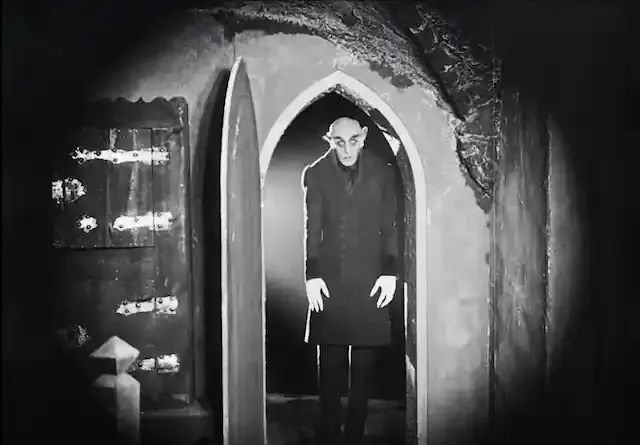
Changing the names and moving the bloodsucking action from Whitby to Germany wasn’t enough to sate the Stoker estate, and the studio was sued out of existence, with all copies of the film ordered to be destroyed. Thankfully prints of the movie survived, and Nosferatu rose again to become the template for horror cinema.
The occultist imagery, spooky effects and biting subtext continue to define a genre, and Nosferatu‘s ghastly apparitions still haunt us after 100 years. Count Orlok (Max Schreck) remains the scariest-looking vampire of all time, whether rising from a casket or simply standing still with his long arms by his sides. He is only undermined by having to carry a coffin around with him wherever he goes.
It is however hard to avoid the antisemitic subtext of the hook-nosed vamp and his disease-carrying vermin, alongside his occultist businessman accomplice Knock (Alexander Granach). Unfortunately these were the tropes of the time, but they are ultimately overshadowed by F. W. Murnau’s black magic behind the camera. His electrifying use of shadow and Baltic atmospherics conjure a state of otherworldly dread, while Stoker’s epistolary style lends itself well to the silent format.
An icon of German Expressionism, Nosferatu‘s century-long legacy speaks for itself.
 Screen Goblin