New Line and Paramount had been threatening to make a crossover Freddy vs. Jason movie since 1987, meaning they had 16 years to think of a way to get the titular twosome together, and after spending $6 million on rewrites, this is what they came up with in 2003: Freddy (Robert Englund) has lost his dream powers because no one remembers him, so he wakes up Jason (Ken Kirzinger) and sends him to kill teenagers so that the town thinks Freddy has returned, thereby letting him back in their dreams. $6 million well spent.
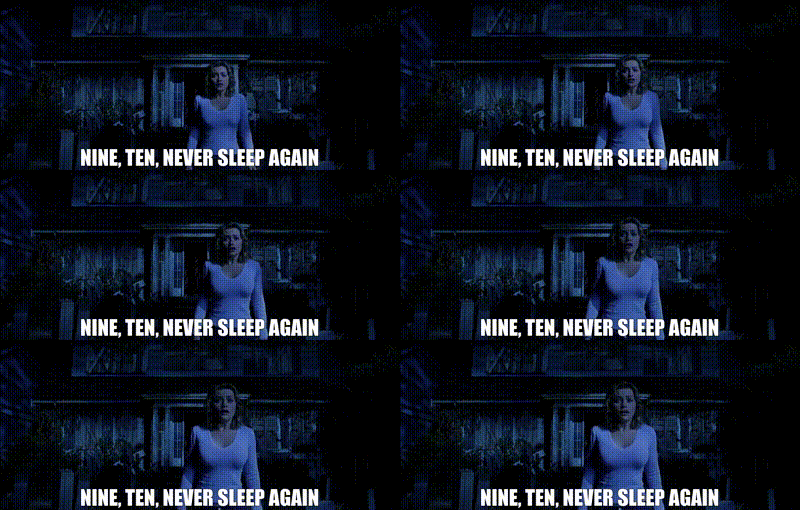
The preposterous premise proves the least of the picture’s problems; between them these franchises had already jumped more sharks than an M. Night Shyamalan remake of Aquaman. In fact this comic book-style crossover is the perfect time to go full B-movie madness, indulge the cartoon campery that ruined the Elm Street movies, or just send Jason into space again. Really, whatever you want to do. Anything at all. Apart from making a film about rape where the hero is a mass murderer. But that hardly seems worth clarifying.
The problem with Freddy vs. Jason as a concept is both characters are immortal and neither has any real concept of pain, so watching them fight is like following the Tory leadership contest: an irrelevant procedure between psychotic creeps who don’t know they’re already dead. So the film decides the way to make us invested is to side with one of the eponymous monsters, and chooses Jason, positioning the serial killer as a misunderstood anti-sex crusader who has simply fallen in with the wrong crowd: the sexually perverted Freddy. It’s basically Alien vs. Sexual Predator.
Even though Jason has murdered 100 more people than Freddy at this point, the fact he kills promiscuous teens supposedly makes him virtuous; he even starts saving the lives of teenagers, literally the opposite of his only character trait. Krueger meanwhile is depicted as a virgin-obsessed rapist, to the point that the human characters try to lure him using their virginal friend as bait. And this is after the script had gone through more edits than a Kate Middleton family photo.
Not only does this false dichotomy force the film to make absurd moral distinctions between characters who between them have killed enough teenagers to fill a modestly sized waterpark, it also makes it fixate on sexual assault and spousal abuse. And while themes of abuse had always lurked in the background of the Nightmare movies, this film makes rape into a plot point, personality trait and punchline, and the results are exactly as fun as that sounds.
This grimness pervades every aspect, from the saturation and characterisation to the homophobic and racist slurs. The film constantly violates its own logic (human characters enter Jason’s dreams), general logic (no one bothers to look for kids who escape an asylum) and basic decency (Kelly Rowland gives Jason mouth to mouth). A novelty flick that should have just been a cheap cash-in of the titans ends up a $30 million slow-motion car crash; not so much a mash-up as a pile-up.
 Screen Goblin