Cowboy-cosplayer Joe Buck (Jon Voight) swaps Texas dishwasher work for New York sex work, only to discover the popularity of cowboys is on the Wayne.
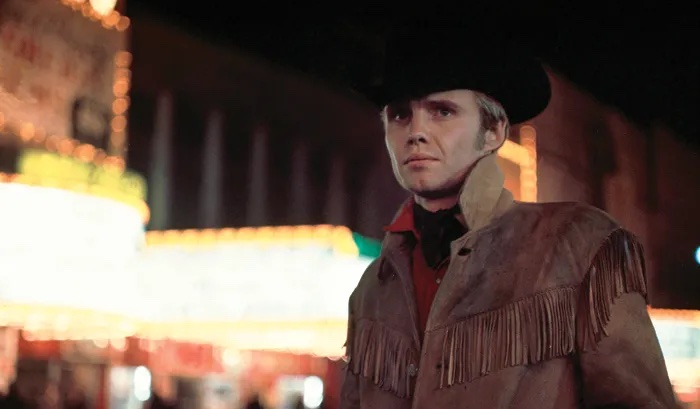
John Schlesinger’s Oscar-winning drama is just as poignant and provocative today as it was in 1969, and remains revelatory in its candid, non-judgemental depiction of sex work, unusually told from a male perspective. But the film also finds humour in the darkest of places, such as when Joe has to awkwardly ask his first client to pay him after they sleep together, ultimately being too polite to force the issue. Voight’s cheerful naivety in the role makes the lighter moments charming and the darker moments all the more devastating, as Joe Buck’s trip out east goes south.
The movie does not dwell on Joe’s backstory that is spelled out in James Leo Herlihy’s novel, but hints at his past in nightmarish flashbacks edited in impressionistic style by Hugh A. Robertson. This allows us to imagine the neglect and abuse that robbed Joe of a childhood, and much of an adulthood to boot. Instead the focus is on his fractious friendship with limping New Yorker “Ratso”, the most heartbreaking Dustin Hoffman performance until he did Meet the Fockers. Both actors were nominated for the Oscar, and ironically both lost to John Wayne.
Schlesinger (one of the first openly gay figures in Hollywood) treats New York’s underbelly and the lost souls who call it home with melancholy affection, ruined only by the overuse of ‘Everybody’s Talkin’ sung by Harry Nilsson, which was only used because Bob Dylan failed to finish ‘Lay Lady Lay’ in time. But John Barry’s woozy harmonica theme provides the perfect backdrop to the characters left drifting by times a-changing, kicked to the curb along with the promise of the American dream. Trump-loving Jon Voight may have forgotten its humanity, but no amount of MAGA bootlicking can take the shine off Midnight Cowboy.
 Screen Goblin