Ghosts enter the living world through the internet in this 2001 J-horror they should have called Ghostbuffers.
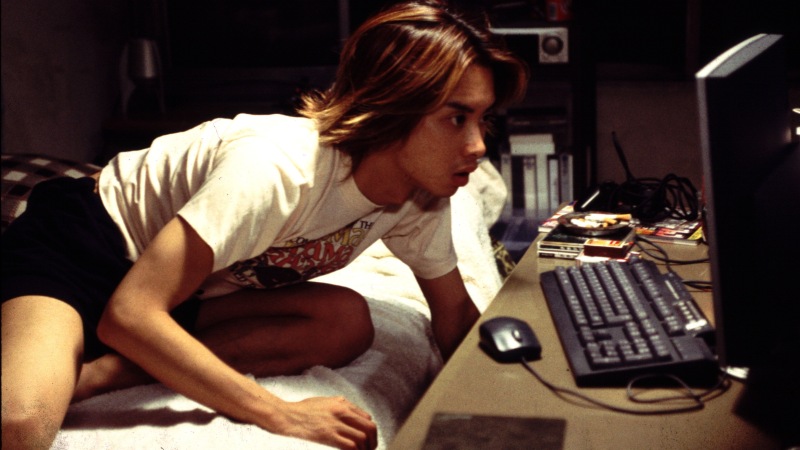
Pulse emerges from the techno-paranoid wellspring of 1998 classic Ring, updating its supernatural media from VHS to the World Wide Web. But Kiyoshi Kurosawa’s allegory sees both sides of the digital divide, tapping into the spirit of connection the web can offer lonely individuals, as well as the horror that awaits them online.
This makes the movie now feel retro (the old-school dial-up tone is creepily deployed) yet ahead of its time, tuned into the mental health scares that would dial up exponentially when social media reached a critical mass. Here the ghosts escape into our world when their realm runs out of space, a digital echo of Dawn of the Dead; when there is no room left in cyberspace, the dead will walk the Earth.
While uncannily prescient in the vein of George A. Romero, the restrained execution is distinctly Japanese, making for a slow and gloomy two hours. But what Pulse lacks in excitement it makes up for in atmosphere, eschewing jump scares and jerking bodies in favour of spectral lighting and slow, haunting motion. Rather than looking like something from another dimension, the ghosts appear part of the everyday, played by humans but blurred and lit in a way that gets under the skin.
But the most chilling interpretation is not supernatural; it is that screens literally reflect urban isolation, as Tokyo becomes as desolate as Threads. The film mirrors the repression of Japanese society and has gone global and viral with the proliferation of devices, our fascination with screens an extension of our refusal to confront death. Pulse is an ambient cyber-chiller about the world sleepwalking into an apocalypse of isolation, and the digital remnants we leave behind.
 Screen Goblin